A mobility test answers two questions a mirror cannot: how far each joint actually moves, and whether your left and right sides move the same. Below are the eight range-of-motion tests Kallen measures with the phone camera, ten movement tests you can do with a wall and a chair, the normal range for each, and what a limit in one place tends to overload somewhere else.
One reading says little; the same test done the same way a few weeks later says a lot. Test at a similar time of day, after a few minutes of walking rather than a long warm-up, with the same setup every time, and always measure both sides before you compare them. Move into the position slowly and stop where the range ends or the body starts to cheat: a knee that bends, a lower back that arches, a heel that lifts. Pain is a stop sign, not a target.
Warm, not stretched: a few minutes of walking, no stretching beforehand.
The same setup every time: the same wall, the same chair, the same distance from the camera.
Both sides, every time: the difference between them is often the finding.
Write the number down or let the app keep it: memory rounds in your favor.
Eight range-of-motion tests the camera measures
Test
Normal range
What it measures
If it is limited, it can overload
Toe touch
55–110°
What it measuresspine and hamstrings
If it is limited, it can overloadThe lower back, which rounds to reach the floor; the knee, which is loaded differently.
Overhead reach
150–180°
What it measuresshoulders
If it is limited, it can overloadThe upper back, which slumps, and the lower back, which arches to get the arms up.
Deep squat
90–140°
What it measureships, knees, ankles
If it is limited, it can overloadThe front of the hip, which pinches at the bottom, and the deep buttock muscles; a squat usually stops at the hips or the ankles, rarely at the knees.
Hip extensionL/R
5–20°
What it measureship flexors
If it is limited, it can overloadThe lower back, pulled into an arch as short hip flexors tip the pelvis forward, and the front of the thigh.
Side split
80–140°
What it measuresadductors
If it is limited, it can overloadThe inner thigh, working at the end of its range, and the deep buttock muscles.
Side bendL/R
20–40°
What it measureslateral flexion
If it is limited, it can overloadNo single link: a side that bends clearly less than the other is the finding.
Ankle bendL/R
30–45°
What it measuresankle and calf
If it is limited, it can overloadThe knee, which makes up the missing range, and the calf and the sole of the foot, kept under tension at every step.
Straight-leg raiseL/R
60–85°
What it measureshamstrings
If it is limited, it can overloadThe lower back, which rounds when you bend, and the hamstring itself, stretched by every stride.
The green band is the typical adult range Kallen grades against. Below it reads as limited, the lower third of the band as fair, the rest as good, its upper end and beyond as excellent. “L/R” marks a test measured on each side.
How a limit in one place shows up somewhere else
The body shares work along a chain. When one joint lacks range, a neighbor usually supplies it, and the neighbor is often the place that hurts. These are the links Kallen’s cause map checks first when you report pain:
Ankle → knee, calf and heel: an ankle that bends less than about 30° makes the knee travel further in every squat and on the stairs, and keeps the calf and the sole of the foot under tension at every step.
Back of the thigh → lower back and knee: short hamstrings tip the pelvis back when you bend, so the lower back rounds to reach the floor, and they change how the knee is loaded.
Front of the hip → lower back and thigh: hip flexors kept short by sitting pull the pelvis forward and the lower back into an arch when you stand, and keep the front of the thigh tense.
Hip rotation → knee, lower back and buttock: a hip that rotates little makes the deep buttock muscles overwork and often shows up later as knee or lower-back complaints.
Upper back → neck, shoulder and lower back: a stiff upper back makes the neck extend to look ahead, limits how far the arm goes overhead and hands rotation down to the lower back.
Chest and shoulders → upper back: a tight chest and shoulders pull the upper back into a slump and make the lower back arch when you reach overhead.
Ten movement tests that need no camera
Besides the eight camera tests, Kallen has 34 movement tests with written instructions. You do them with a wall, a chair, a tape measure or a stopwatch, and the app keeps the result for each side. These ten are the ones people search for by name and the ones that say the most about mobility. The table shows what the app counts as a good result and what a weak one usually points to.
Ten movement tests worth knowing
Test
A good result
A weak result points to
Knee-to-wall testL/R
A good result10 cm or more per side
A weak result points toUnder 8 cm: tight calves and extra stress on the knee. A side gap over about 1.5 cm is a finding of its own.
Thomas test
A good resultThigh flat on the table, knee bent about 90°
A weak result points toThigh floats up: short hip flexors. Knee stays fairly straight: a tight quad.
Seated hip rotationL/R
A good resultFree and easy, the same on both sides
A weak result points toLimited or one-sided internal rotation, which often shows up later in the knee or the lower back.
Standing forward fold
A good resultPalms or fingertips on the floor
A weak result points toStopping at the shins usually goes with a stiff lower back or tight hamstrings.
Apley scratch testL/R
A good resultFingers touch behind the back, both ways
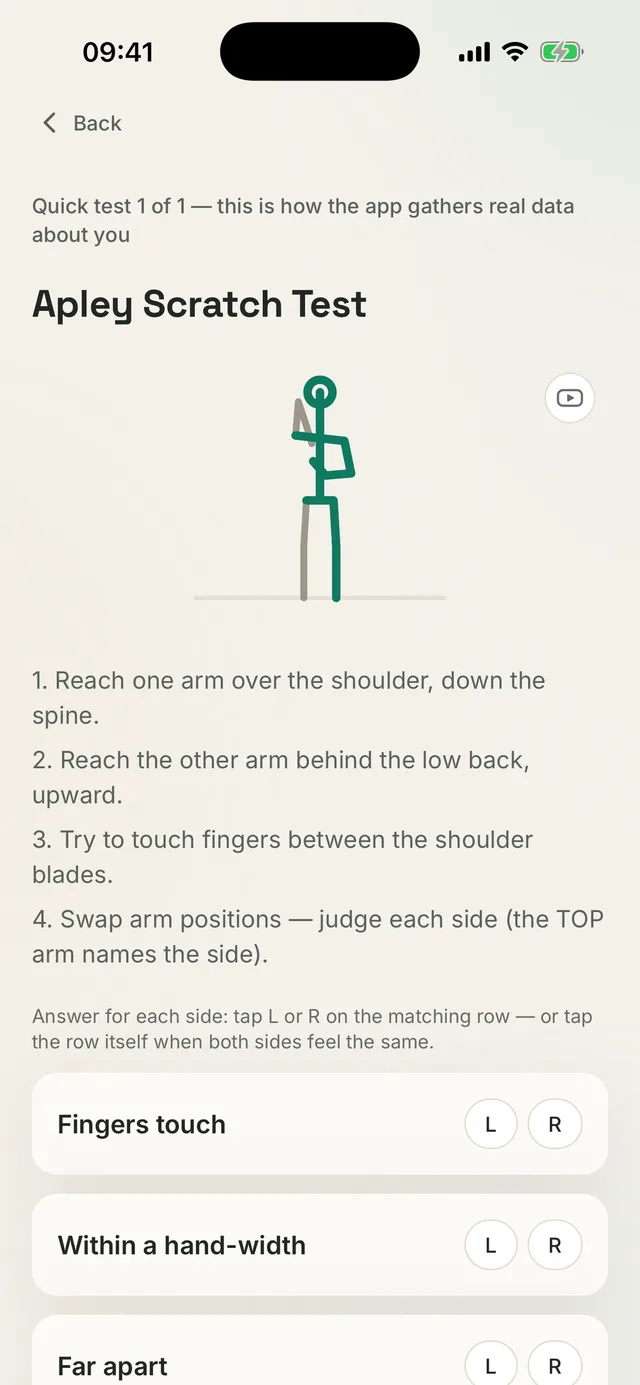
A weak result points toA big difference between the two sides is the key finding.
Seated thoracic rotationL/R
A good resultShoulders turn past 45° each way
A weak result points toOne side clearly behind the other matters more than the total.
Neck rotation checkL/R
A good resultChin reaches, or nearly reaches, the line of the shoulder
A weak result points toA stiff or painful side is the finding.
Wall angel
A good resultArms stay on the wall through the whole slide
A weak result points toA lower back that arches or wrists that float off: a tight chest and a stiff upper back.
Overhead squat screen
A good resultDeep squat with the arms staying overhead
A weak result points toArms fall forward: upper back or lats. Heels lift: ankles. Knees cave in: hips.
Big toe extensionL/R
A good resultAbout 60° of easy lift
A weak result points toA stiff big toe changes how the whole foot pushes off.
Pass marks as the app grades them. “L/R” marks a test recorded on each side. Kallen has 34 movement tests in all; these ten say the most about mobility.
When one side is stiffer than the other
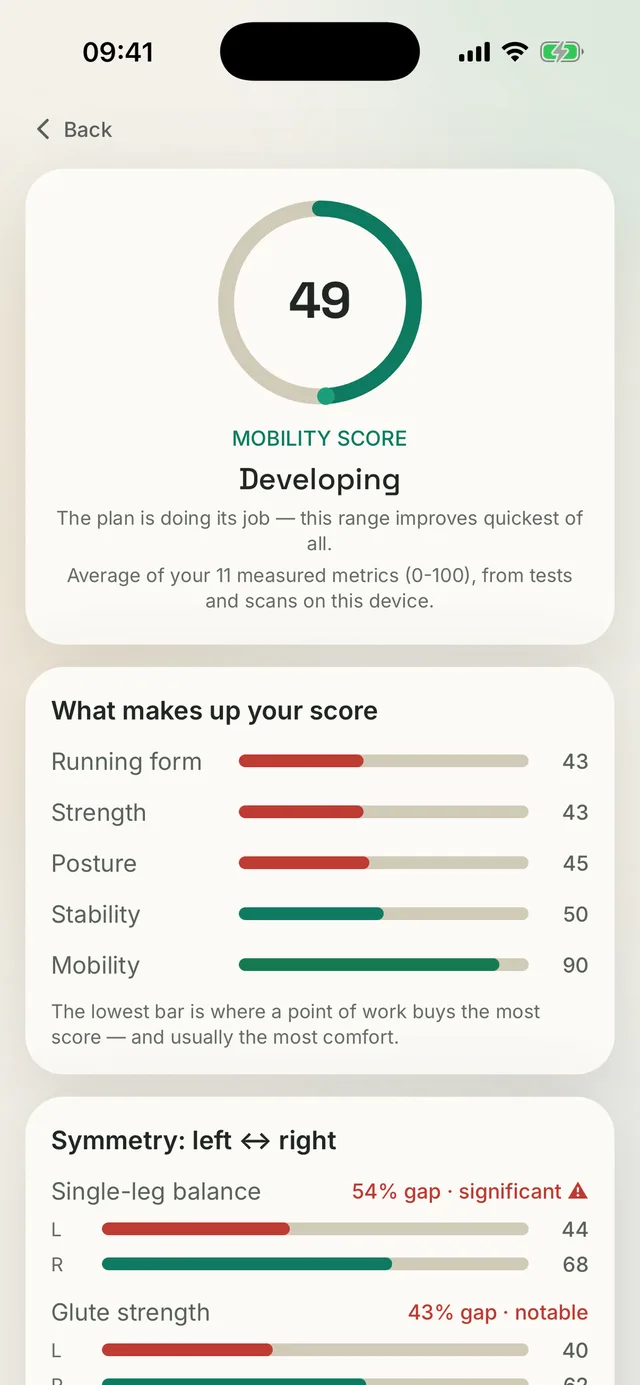
A difference between the sides often matters more than the number itself. One stiff ankle is a common example: the knee on that side bends further in every squat and on the stairs to make up for it. Kallen records left and right separately in every one-sided test and grades the gap against the norm for that particular measurement, as symmetric, notable or significant. It does not compare two readings taken more than four months apart, or a reading it was unsure about.
What to do with the result
Start with the limit closest to what bothers you, not with the lowest number on the list: a stiff ankle matters more to someone with a sore knee than a modest side split does. Work on it for a few weeks, then repeat the same test the same way. In Kallen every reading updates your Movement Profile and can change your plan, and the coach proposes each change on a card you approve first.
Limited and painless: train it if it holds back something you want to do.
Limited on one side only: start with that side.
Painful during the test: stop, and let the protocol for that area guide you before you test it again.
Do I need to stretch everything that tests below normal?
No. A limited range that does not bother you and does not stop you from doing something you care about is information, not a problem. Start with the limit linked to your complaint or your sport, and with the side that is clearly behind.
Can a phone camera measure range of motion accurately?
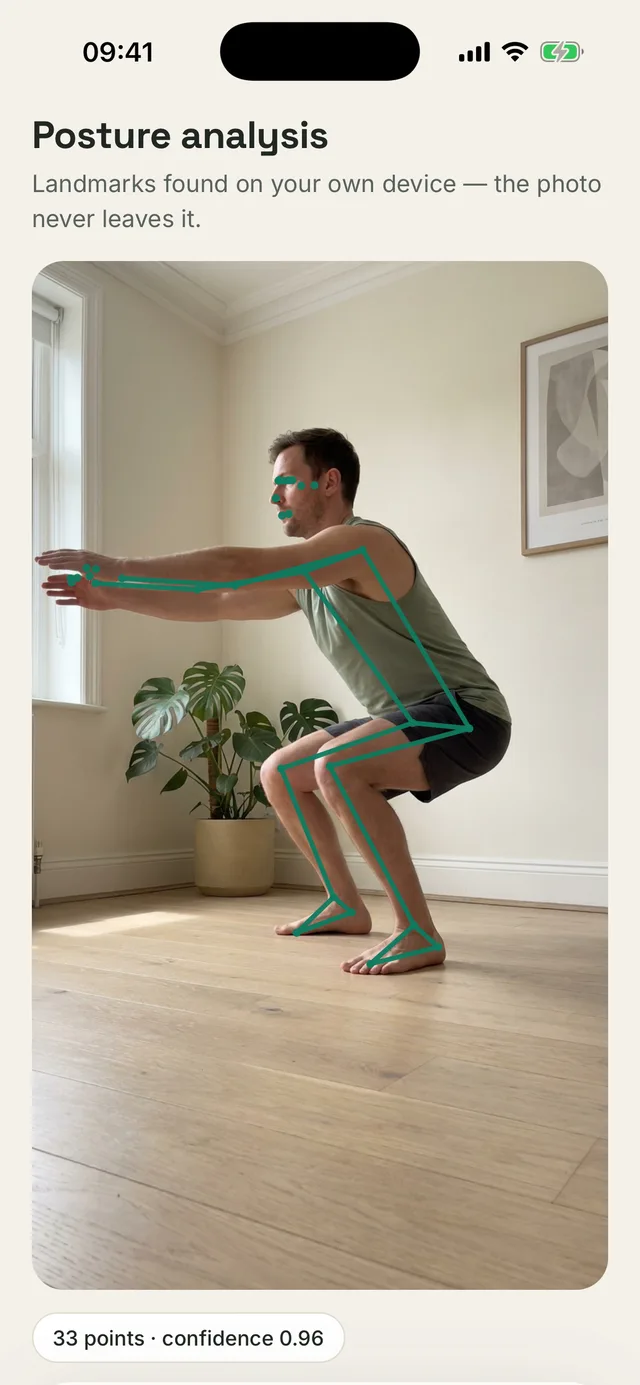
Accurately enough to compare you with yourself: the same test, done the same way, read the same way. Kallen finds 33 body points in the frame, calculates the joint angle, waits for the right position before it counts and does not compare a reading it was unsure about. It is not a clinical goniometer, and it does not diagnose anything.
Should a mobility test hurt?
No. Go to where the range ends, not to where it hurts. Pain during a test is a reason to stop, and if it keeps happening, a reason to have the area assessed by a doctor or a physical therapist.
Specifics
Short answers, with numbers
Concrete answers to the questions people ask about testing their own mobility.
01
What is a normal ankle range of motion, and how do I test it at home?
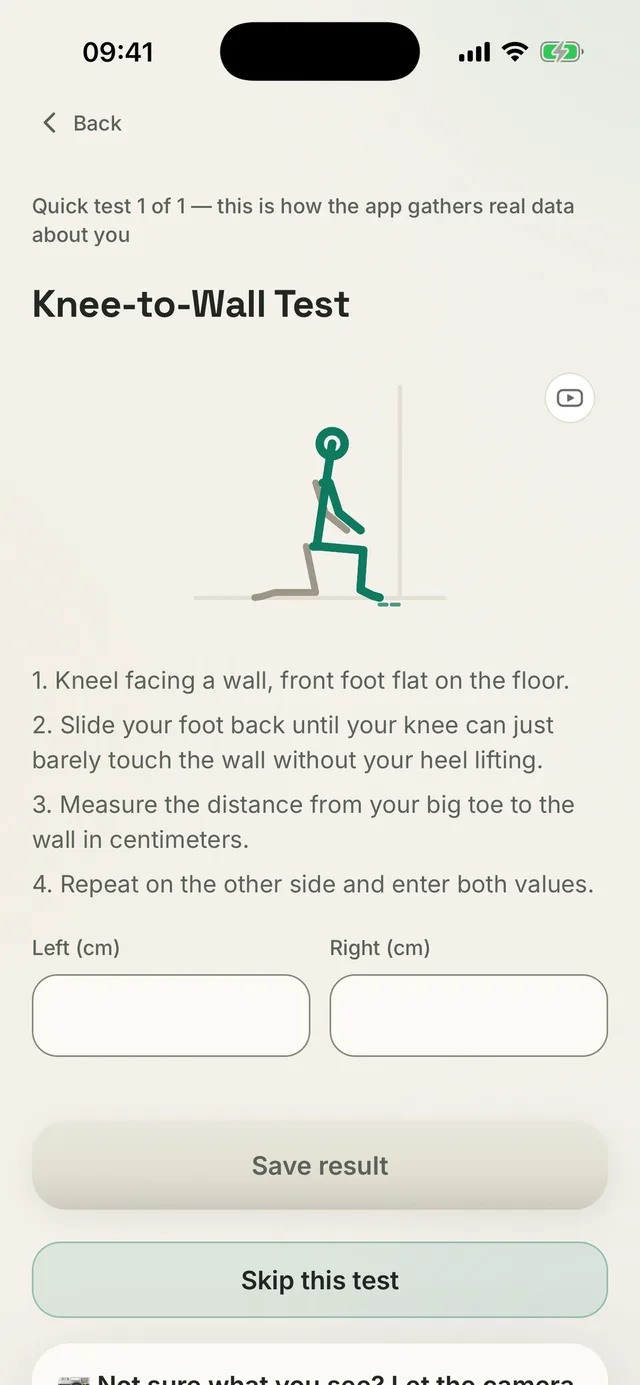
In a weight-bearing lunge, a shin that leans 30–45° forward is the typical adult range, and under 30° is a restriction worth training. The simplest home version is the knee-to-wall test: 10 cm or more between your toes and the wall on each side is healthy, under 8 cm often goes with tight calves and extra stress on the knee, and a left-right gap over about 1.5 cm is a finding of its own. Kallen measures both: the angle with the camera, the centimeters with a tape.
02
Which mobility tests should I do first if I sit all day and my lower back or neck feels stiff?
Start with four. The Thomas test or the camera hip-extension test for the hip flexors (the typical range is 5–20°), the straight-leg raise for the hamstrings (60–85°), seated thoracic rotation for the upper back (past 45° each way is solid) and the wall angel. Those are the measurements Kallen’s cause map checks first for lower-back and neck complaints.
03
How often should I retest my mobility to see real progress?
Give a limit a few weeks of regular work before you judge it, then repeat exactly the same test the same way, ideally at a similar time of day. Range changes slowly, and a reading taken every few days mostly shows day-to-day variation. In Kallen, camera tests can be repeated once a week on the free plan, and a good reading older than about six weeks is measured again rather than trusted.
Inside the app
Two ways Kallen measures
For range-of-motion tests the camera reads the angle; for the rest the app guides you step by step and keeps the result for each side.
Degrees instead of “about halfway”
A deep squat seen from the side: the app finds 33 body points and calculates the joint angle, and waits for the right position before it counts.
A wall and a tape measure
The knee-to-wall test takes about two minutes and stores centimeters for each leg, so the next test has something to beat.
Each side, one tap
Apley’s test is recorded separately for left and right, because the difference between them is usually the finding.
Check your own results
Measure your range of motion in Kallen, build your Movement Profile and follow the plan step by step.