The painful spot may not tell the whole story
A painful area may be taking on extra work because a nearby joint or muscle is not contributing enough. In that case, stretching the sore spot may bring relief without changing the reason it became overloaded. Kallen does not assume which possibility applies to you. It keeps a shortlist for each painful area and checks every item against your own measurements.
- Lower back: hip flexors held short by sitting, tipping the pelvis forward.
- Lower back: glutes that went quiet, leaving the back to do their lifting.
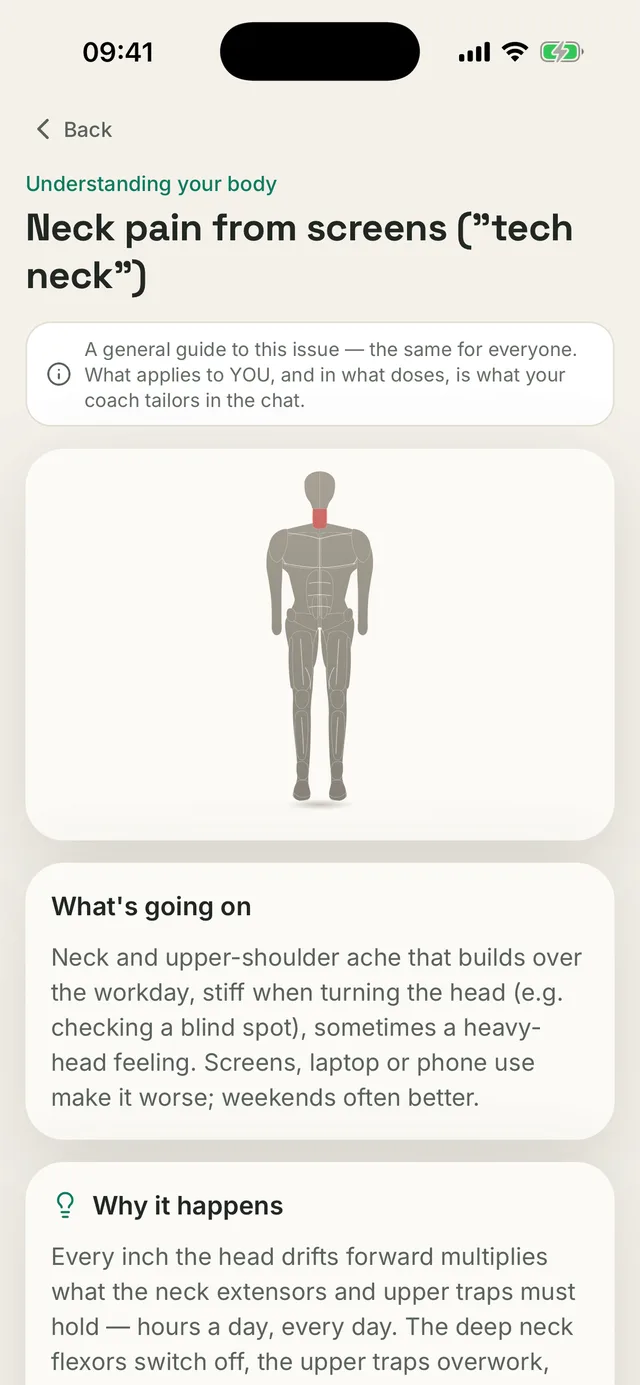
- Neck: a stiff upper back that asks the neck to extend further to keep your gaze ahead.
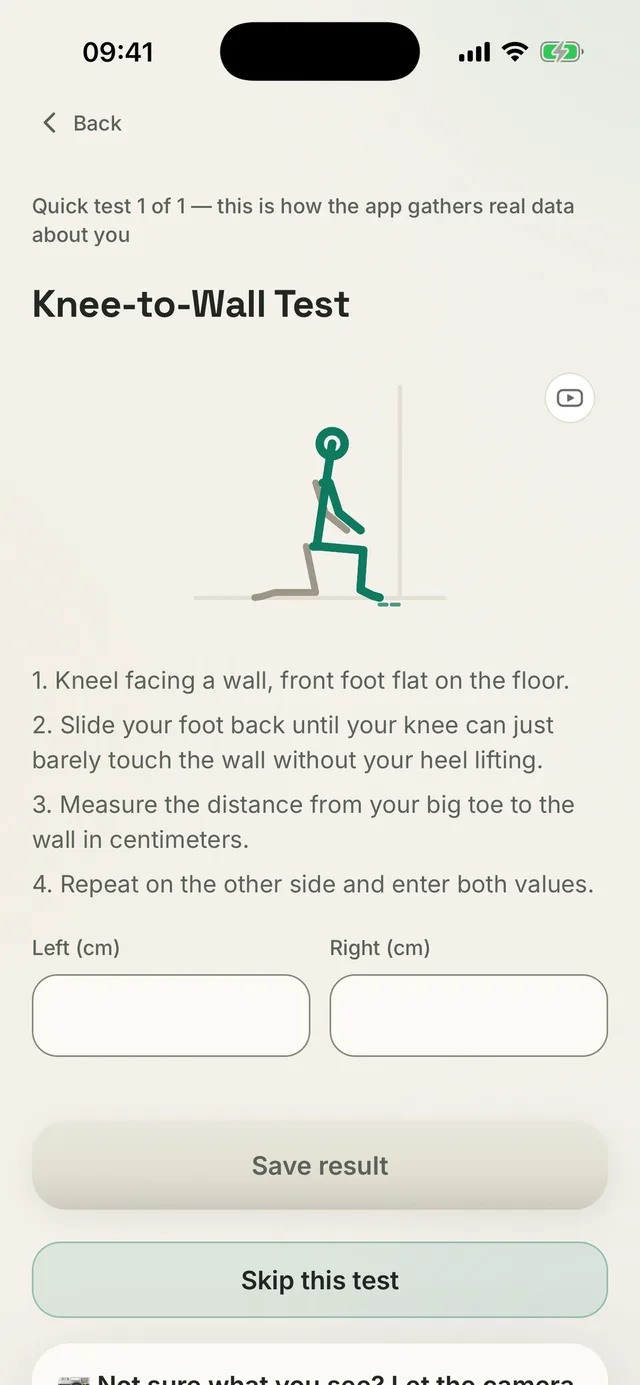
- Knee: a stiff ankle on the same side, with the knee making up the range it cannot.
Your knee hurts
We check the ankle
Your neck hurts
We check the mid-back
Your wrist hurts
We check the neck
The three answers a measurement can give
This is not a diagnosis. It is an organized shortlist, with a reason beside every item. A measurement puts each possibility into one of three states, and every state helps narrow the next step.
- Supported: something in your own data backs it, such as a weaker glute on that side, a limited range or a flagged region.
- Not yet checked: the measurement is missing. One test closes it.
- Looks fine in the data: the reading is healthy, so that line drops out and does not return at the next review.
- A test that would load the part that hurts is never offered. You check the neighbor, not the wound.
- A healthy reading older than about six weeks settles nothing. You measure again rather than trust an old number.
The second reason: the plan ends the day the pain does
Pain can ease before the capacity you need has returned. The tissue may feel calmer but still struggle with the load that triggered the symptoms, so a demanding week brings the old problem back. That is why a phase in Kallen ends when you can do something specific, such as hold a position or complete a full desk day without a flare, rather than when a set number of weeks has passed. When a plan has not helped, the first question is how many sessions actually happened. Completing fewer than half is too little to judge the plan. The next step is a smaller dose, not a different exercise list.
What Kallen can track between appointments
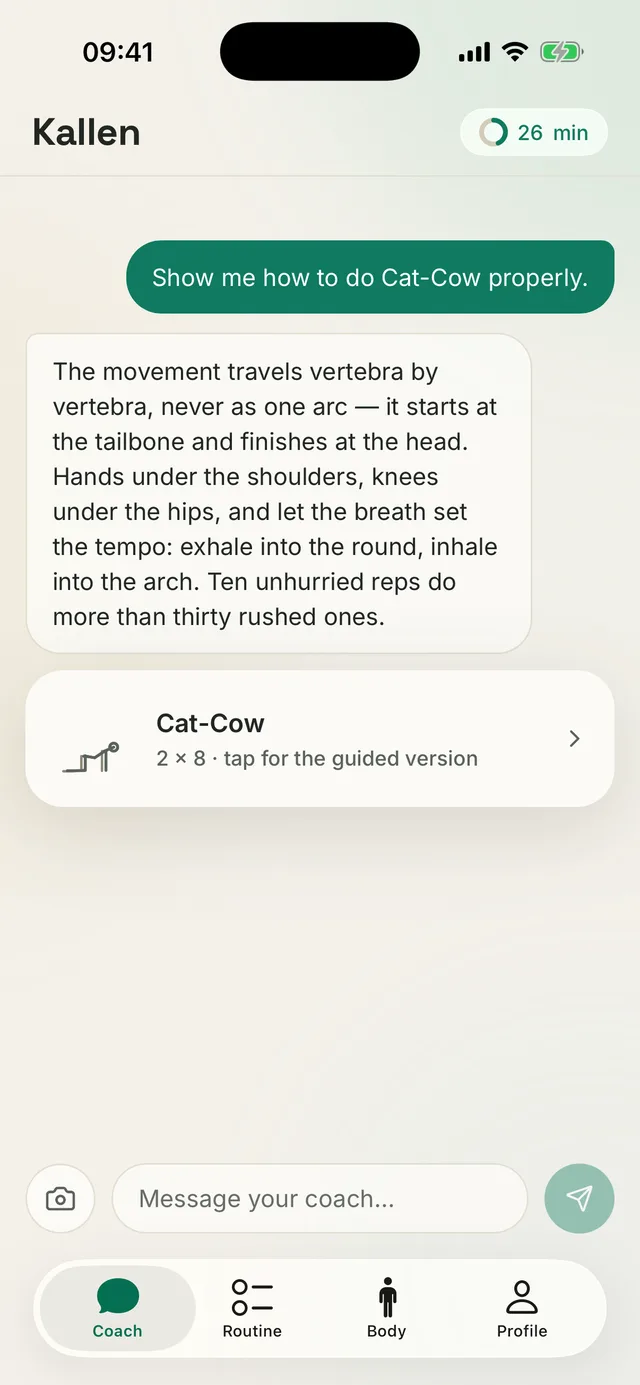
An appointment gives you what an app cannot: a live assessment, hands-on examination and a decision from a professional who is accountable for it. Kallen supports what happens between appointments. It can repeat the same measurement in week six, place today’s result beside the number from three months ago and connect an earlier hip measurement with lower-back pain reported later. That is the limit of its role. It does not examine you with its hands, diagnose you or deliver post-injury rehabilitation. Every protocol opens with the signs that warrant an in-person assessment, and the coach names them plainly while continuing to guide you through what is safe. Between appointments, Kallen does four things:
- Keeps the number from three months ago and puts it beside today’s, using the same test in the same way.
- Compares your left and right in degrees and seconds, not from memory.
- Holds 24 protocols in one place, together with what tells similar complaints apart.
- Comes back to an old case weeks later, because it wrote down where it started: the pain, the ranges and the region statuses from that day.
Common questions
Does this mean the exercises I was doing were wrong?
Usually not. A recurrence is mostly a story about dose and timing: the work stopped when the pain did, or nothing ever changed about what was loading the area. The same exercises often work perfectly well once they run long enough and the cause has been checked rather than assumed.
How do I know the cause is somewhere else?
Three things pointing the same way: the sore spot itself measures fine while a neighboring one does not, the pain returns at the same load every time, and one side is clearly behind the other on a test. None of them proves anything alone, which is why they are read together instead of one at a time.
When does recurring pain need an in-person assessment?
Some signs are not a recurrence question at all. Numbness around the saddle area, or new bladder or bowel trouble, means emergency care immediately. Leg weakness that is getting worse, fever, unexplained weight loss, a hot swollen joint, or pain after real trauma need a professional promptly. Every protocol in Kallen opens with a list like this.
Will the app tell me what is wrong with me?
No, and it does not try to. It gives you a shortlist of factors that could be loading the area and shows which ones your measurements support, which remain untested and which look fine in the data. It also tells you which measurement would help assess the open possibilities.