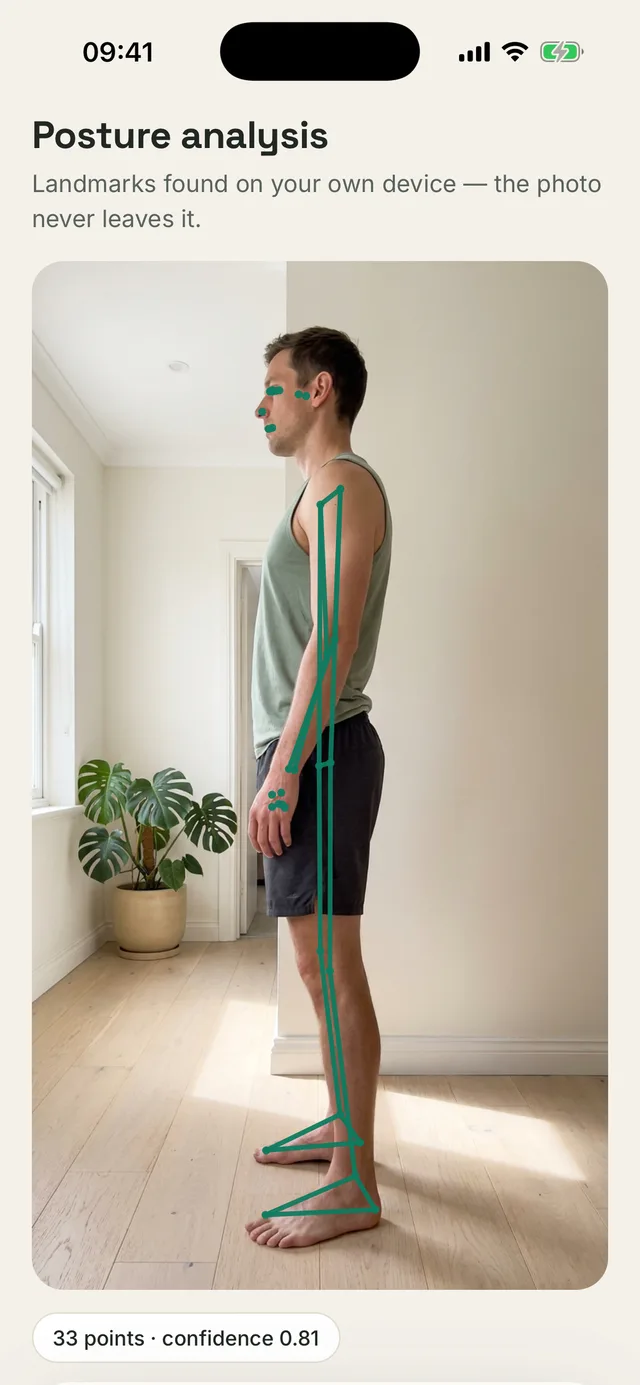
What it usually looks like
Shoulders roll forward and inward, the chest looks closed and the upper back rounded; visible in photos and how shirts sit. Usually pain-free at first; often paired with forward head and a tight chest from desk work or lots of pressing in the gym.
Why it happens
Hours of reaching forward (keyboard, phone, steering wheel) shorten the chest and front-shoulder tissues while the mid-back muscles that pull the shoulder blades back go under-used; add gym routines that press twice as much as they pull and the shoulders live rolled forward. Balance the pulling, open the front, and the blades settle back where they belong.
Clear answers and practical doses
Find specific answers about setup, dosage and timing, with the same numbers shown in the plan further down the page.
01
How long should I hold a doorway chest stretch for rounded shoulders?
3 × 30 seconds daily, at two elbow heights. That is the protocol’s first phase, lasting 2–3 weeks. A doorway is always nearby, so it fits into desk micro-breaks. Stretching opens the front but will not hold the result on its own: the next phase strengthens the muscles that pull the shoulder blades back.
02
What pull-to-push ratio fixes rounded shoulders?
At least as much pulling as pressing, week by week. It is worth auditing in your training log. The second phase is 3 sessions a week of 2–3 sets of 12–15, shoulder blades down and back with no shrug; in the third, face pulls 2–3 times a week stay in the plan for good.
03
Where should chair armrests sit so my shoulders stop rolling forward?
Where the elbows rest slightly BEHIND the ribs, not in front of them. Otherwise the arms pull the shoulders forward all day. It is one of three self-care rules in the Kallen protocol, next to doorway stretches in micro-breaks and the pull-press balance in training. You feel the change in 2–3 weeks and see it in 6–10.
When to see a professional
- Pain, clicking or weakness with overhead reach; assess as shoulder_pain first.
- One shoulder visibly different from the other after trauma; get it checked.
These signs do not mean you must stop moving. Have them assessed in person and continue only with movement that is safe for you.
What you can do from today
- Audit the training log: pull at least as much as you press, week by week.
- Doorway stretch during micro-breaks; the doorway is always there.
- Set the chair armrests so the elbows rest slightly BACK of the ribs, not forward.
In Kallen: turn on Reverse Sitting
Start a 25, 45 or 60-minute work block and let Kallen track the time. When it ends, Kallen draws one of 19 Mobility Snacks matched to the tight areas in your profile. Each takes 35–50 seconds; 10 can be done seated and the rest standing beside your desk. Then you return to work.
Your plan, phase by phase
This is how the protocol appears in the app. The coach adapts the pace and dosage to your measurements. You advance when you meet the phase criterion, not when a date arrives.
Phase 1 · 2-3 weeks
Open the front
Goal
Give the shoulders room to sit back; release chest and lats
Dosage
Doorway 3x30s daily at two elbow heights; ball release 60-90s per side, slow.
Move on when
Standing tall stops feeling like pulling against a bungee cord.
Exercises
Doorway Chest StretchPec Ball ReleaseWall Lat StretchPuppy Pose
Phase 2 · 3-5 weeks
Strengthen the pullers
Goal
Mid-back and rear-shoulder strength; the muscles that park the blades back
Dosage
3x/week, 2-3 sets of 12-15; slow squeezes, blades down-and-back, zero shrug.
Move on when
Rows and pull-aparts feel strong; shoulders sit back without conscious effort for stretches of the day.
Exercises
Band Pull-ApartProne Y-T-WBand Row
Phase 3 · 3-6 weeks
Make it the default
Goal
Integrate the open position into pressing, overhead work and long days
Dosage
Face pulls 2-3x/week as a permanent training-diet staple; wall angels as the weekly form check.
Move on when
Photos show open shoulders; pressing days no longer roll you forward for the evening.
Exercises
Band Face PullWall AngelSuperman Hold
How long it takes
Feel changes in 2-3 weeks, visible change in 6-10. The pull-press balance in training is what makes it permanent; face pulls are forever, and that’s a good thing.
Common questions
Do posture correctors work for rounded shoulders?
They give you a reminder, not a change. The first days feel better because the brace prompts the position, but the muscles meant to hold your shoulders there still are not working. Treat one as an alarm clock for a few weeks alongside the exercises, never instead of them.
Why is squeezing my shoulder blades not enough?
Because the problem rarely sits in the blades. You usually need to open what has shortened at the front (chest, front of the shoulder), build endurance at the back, and free a stiff upper back that otherwise blocks everything else.
How often do I need to train?
Two or three strengthening sessions a week is enough, provided short movement breaks happen during the day. Consistency across 6–8 weeks is what matters. That is the pace muscular endurance changes at, and no intense weekend shortens it.